
chromebooks.

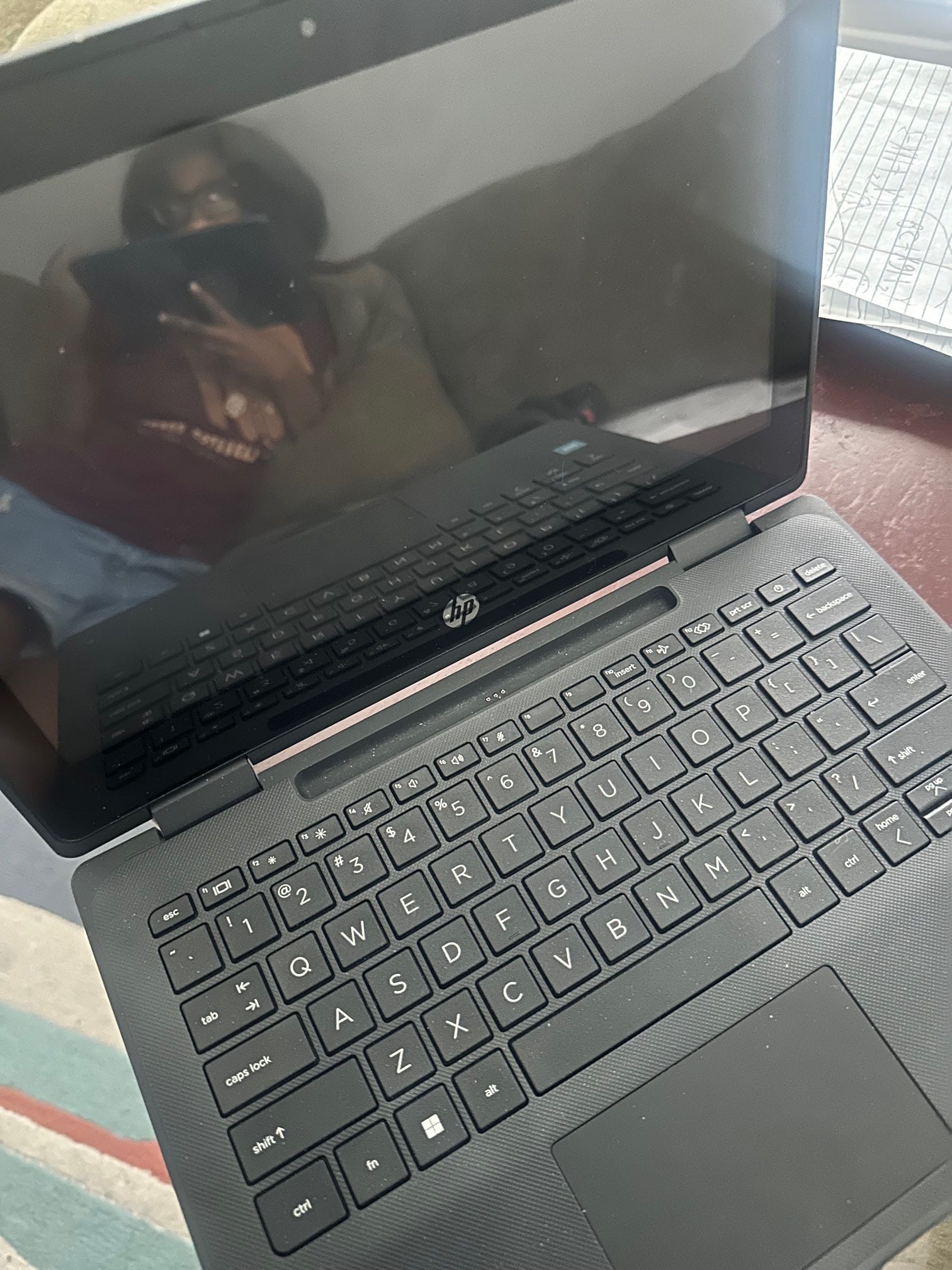
In January, before the end of the first semester, I pulled up to my daughter’s high school and parked in the lot beside the campus green. School started two hours earlier, so I thought I timed the visit perfectly. Conditions were ripe for an unobtrusive entrance and exit. I’d slip her school-issued Chromebook across the desk in the front office and be back in my car before anyone noticed. This was how I wished to end my daughter’s stint as a traditional high school student: quietly and without question.
If I’d left the car as soon as I parked, my wish may have been granted. But I was hesitant. The late-morning air was frigid and, as usual after six years spent as a North Carolinian, I was grossly underdressed for the cold.
Apart from my climate-related procrastination, I just needed a minute to sit with circumstances. Once I entered the school, it would truly be over, at least for the rest of her ninth grade year, and though I’d given it this decision due diligence, I couldn’t be certain it was the right one.
We are not unaccustomed to pivots. We’ve been making them since Story was a toddler. She was nearly three and still barely talking when a county-run early intervention program visited our home, conducted a battery of assessments, and determined that Story was eligible for enrollment in public preschool. From preschool through kindergarten, she attended Campfield, an early learning center designed for kids with special needs.
There, I learned what it would be like to bring my concerns to a biannual table of educators who spent substantial time with my daughter without me present. They were learning more about how she listened, spoke, and processed information than I could determine at home.
Special needs are emergent and evolving. New ones crop up as others recede. Some seem to hide themselves altogether. They can be latent or elusive for years before detonating, mushrooming, and eclipsing everything else.
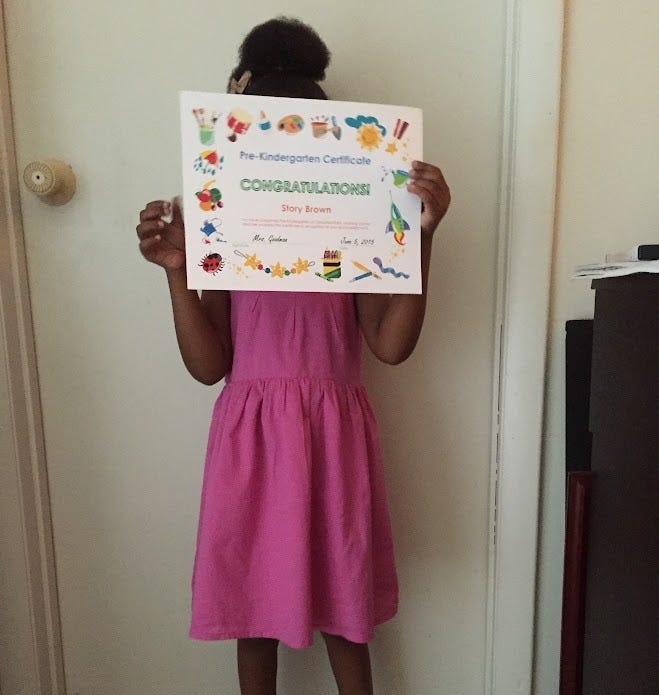
For first grade, the zone school Story should’ve attended — incidentally, one of my own elementary school alma maters — did not seem like an ideal fit for her. So we took a… non-literal approach to our proof of residency and enrolled her in the school across the street from her paternal grandparent’s house. It was in a homeowners’ neighborhood, which meant slightly better funding, resources, and ability to sufficiently accommodate an individualized education plan.
A mother must be inventive. A single mother must make new worlds materialize. Once she realizes she cannot provide the specific, specialized, expensive learning environments her child will require, she must learn to trail her finger along life’s well-worn maps and be prepared to chart new courses whenever once-reliable roads can no longer be traveled.
By the end of fifth grade, Story had attended three different schools and had four different learning experiences. After Campfield and the school right after it, there was a liminal year and a half where she wasn’t enrolled anywhere at all.
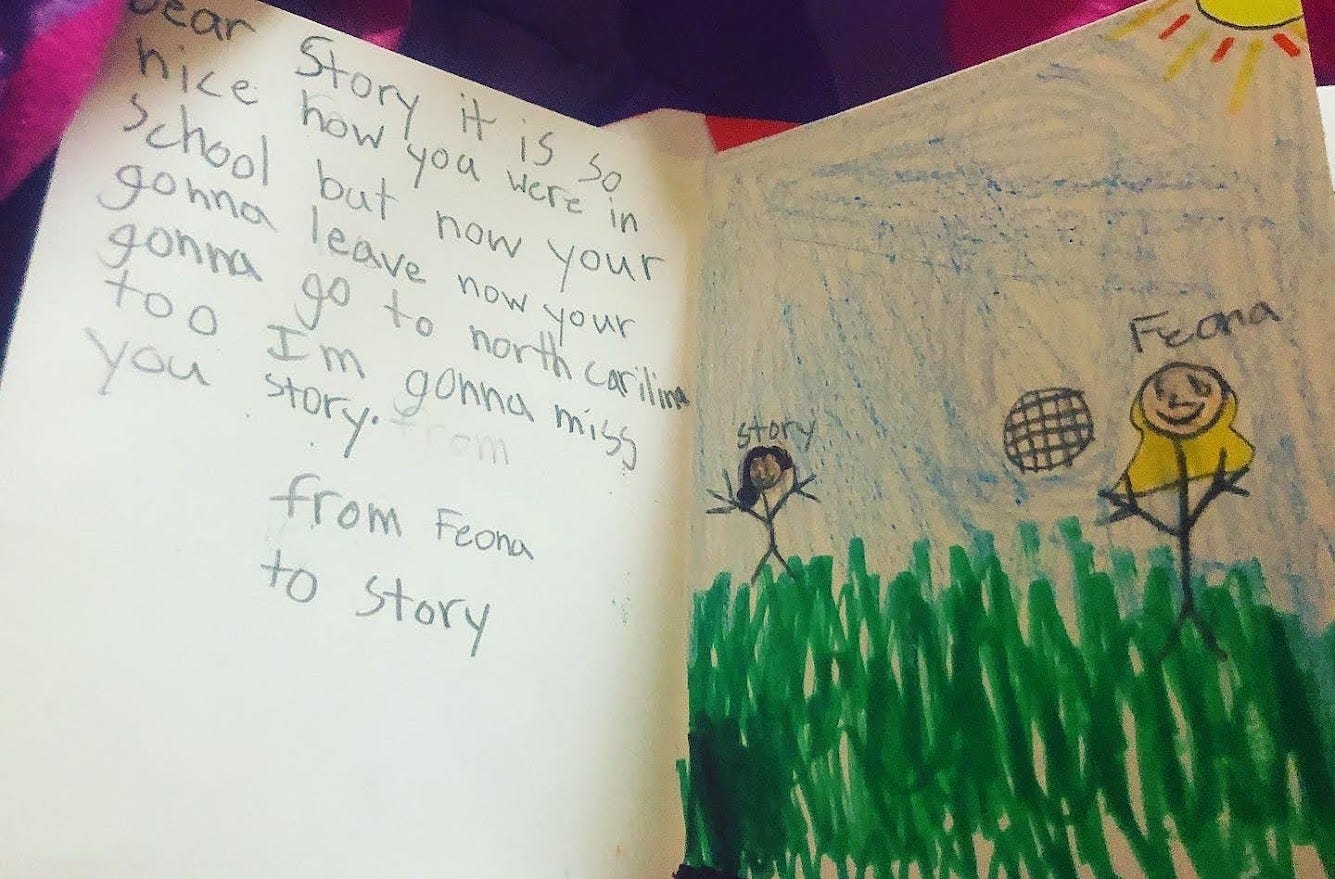
The first week of March 2020, I visited Story’s third-grade class to drop off two packages of black greeting cards, along with bags of assorted candy, for her teacher to distribute to her class. I’d arrange for her teacher to provide time for the students to write their farewells.
Story and I were moving from Baltimore County to Durham, NC, so that I could start the first full-time job I’d had in more than a decade. The day I took the greeting cards to her class was also the day I withdrew her from school. We were meant to get her enrolled at her new school the following week.
But that week happened to coincide with the start of the country’s near-universal Covid shutdown.
Story would spend the second half of third grade disenrolled from public school altogether, officially removed from the rolls at her Baltimore school and stuck in enrollment limbo at her North Carolina one. While most school were experimenting with remote learning models before they got a more formal handle on it in the year to come, Story’s Baltimore teacher told us she was welcome to join in their informal class meetings on Zoom, but whenever she did, it only seemed to leave her feeling lonely and disoriented.
Fourth grade was similarly surreal for her. She found herself one of very few students in a Zoom classroom with kids she’d never met in-person school. Most of her class had attended elementary school together in previous years. Academics proved challenging enough for her that her teacher recommended an extended school year. The summer following fourth grade was the first in which she would resume in-person learning.
But fifth grade would mark a real test of her social mettle. Her first full year back in a classroom, in an entirely new state. It took two quarters but by the second half of the year, Story found a tribe: a core group of girlfriends to play with at recess and eat with at lunch.
It was the last year I saw her happy in a school environment.
I’d been dreading parenting through middle school since the day I found out I was pregnant.
Middle school is a cauldron of hormones, a hotbed of hostility and hurt. For years, I shuddered to imagine what middle school might hold for my child. It has been the worst era of my own childhood and I worried history might repeat itself.
But after her great last year of elementary school, I found myself harboring hope that sixth grade might be better than I’d anticipated.
It was not.
Story’s middle school was predominantly Black and Brown, from the student body to the administration, and that was a bonus. It provided cultural continuity with her school experiences in Baltimore, something I’d been missing ever since we moved further South. But her middle school was also chronically overcrowded and underfunded. The special education department had a hard time accommodating her IEP. She was drowning academically and her teachers were too overwhelmed to provide her the attention she needed. The only time a teacher corresponded with me in a timely fashion that year was the one time Story’s academic frustration resulted in an eventual behavioral incident.
Above all, my daughter was just… dispirited. Every day, she came home weepy and demoralized. Every day, it felt like there was too little I could do about it.
When summer hit, we moved. I’ve never known how to navigate school choice. Beyond magnet schools, which I attended myself for middle and high school, I didn’t know the first thing about applications or lotteries or wait lists or charters.
What I knew how to do was move.
I felt like my only recourse was to rent in a “richer” neighborhood. I paid hundreds more than I had at our old apartment, but at the new middle school, I saw an immediate shift in the administration’s attitude toward my daughter and her IEP. It was a fair trade.
During the first ten days of Story’s seventh grade year, I received three phone calls from three different members of her educational team. Each of them greeted me with some variation of: “Just introducing ourselves! Just looking to learn more about Story and what her experiences have been like so far!”
It was the most personal attention I’d ever received as a public school parent, perhaps with the exception of the great care we enjoyed at Campfield seven years before.
It should’ve come as no surprise when I received another phone call, less than three months into the school year, from a speech therapist who was calling to introduce herself… and to ask me if I’d consider having Story assessed for autism spectrum disorder.
I have long wanted to write about this but even now I scarcely have the words. It is only with two years’ distance from that initial assessment that I can even begin to express what it’s meant for me, for Story, and for our family.
For now, I will only say that I fully believe we would not have this information, had we not moved to a better-resourced public school district.
In many ways, high school proved more tumultuous than middle school. One quarter in, I began to wonder how we would make it through the next three days, let alone the next three years.
There aren’t many free, public, accredited alternatives to traditional high school that don’t require me to take on the entire weight of my daughter’s education on my own. I’d never tried homeschool before now because I had no idea how to balance it with my work schedule — or with my non-existent K-12 teaching background and licensure.
But I did manage to find what I hoped was a viable option: a remote learning institution that is part of the state’s public school system, where each of Story’s classes are taught by experienced public high school educators.
It sounded to good to be true, and after the five weeks we’ve spent enrolled, I’m beginning to suspect that it is. Still, if the six in one hand is a child who struggles daily to navigate a school day and the half a dozen in the other, is a complicated web of academics help her sort through, I suppose, at least for now, we’ll take the latter.
In early January, as I sat in my car outside Story’s high school, students started streaming out of each exit door onto the lawn. I’d procrastinated a few minutes too long. Now the kids were on lunch break, quickly forming their social clusters: flirting, flipping, and pulling their prohibited phones out of their backpacks. I studied the different configurations, looking for points of commonality. Some shared a similar fashion sense. Others gathered according to musical, athletic, or conversational interests. Some were circling the school resource officer, bonded in their shared need to chip away at an authority figure’s stony exterior.
I couldn’t imagine my child feeling comfortable in any of these groups.
In the front office, the secretary’s face fell when I told her I was there to return school property. “My girl is leaving us?”
I returned her bittersweet smile. Story was a familiar face in the front office, in the counselor’s offices, and in stairwells crowded with the likeminded students who looking to dodge the lunch crowds on the campus green and the cafeteria.
Despite the fraught nature of the past four months, the secretary’s question made me second-guess our decision to leave. In some ways, it felt like I’d barely given traditional high school a chance. In others, it felt like we’d exhausted its possibilities.
The secretary at the high school was one of us. Her, “My girl is leaving us?” left me lingering on what we’d be giving up. For our Black daughters, trusted Black women administrators (like Story’s 7th and 8th grade school principal), counselors (like her 8th and 9th grade counselors), educators (like the ones she’d grown up interacting with in elementary school back in Baltimore), and staff (like this woman behind the desk in the high school front office), are invaluable advocates. When we drop our kids off in a physical space filled with women whose very language embraces and claims and includes them, we can exhale during the hours we spend apart.
“Maybe she’ll be back,” I offered in a voice that sounded unconvincing, even to myself. “We’re only testing this other school out.”
A day after I dropped off Story’s Chromebook, a different one arrived via UPS. It bore different school branding and bar codes. It was newer, with more capacity to provide clear and sharp camera coverage.
She logs onto it for four classes a day in the comfort and quiet of our home. I can confirm that it’s been life-changing in terms of her daily temperament. In a reversal of a near-daily teen experience, she has not shed a school-related tear since she left her brick and mortar high school. But there are also no opportunities for her to connect with in-person peers during a school day. The social support layer of instruction is greatly diminished.
And the academic path is perplexing and thornier.
There is no way of knowing for sure. No way to predict what will ultimately be best for a child. That’s the only parenting postulation of which I am entirely certain.
Suffice it to say, my daughter’s education will progress as it always has, with a careful eking out of observations, applications, and objectives, with an expansive approach to what’s possible — even if it means moving from county to county, getting Basquiat-level creative, or talking to an entire school system through the camera lens of a Chromebook.
always love hearing about your lived experience. it makes me question how we all get along in a world that's sometimes difficult to navigate. wishing you and Story the best...
oh stacia. this sounds like a lot to navigate. sending you and story so much love.